KDMS Spezialisiertes Orthopädisches Krankenhaus
KDMS Spezialisiertes Orthopädisches Krankenhaus
Thailand, Bangkok
Jirachai Pisutbenya
19 Jahre der Erfahrung
Klinik ist zertifiziert :
Wirbelsäulenchirurgie in Thailand kostet im Allgemeinen zwischen $10,700 / 395,900฿ und $24,100 / 891,700฿. Die endgültigen Preise hängen von der Komplexität des Eingriffs, dem Standort des Krankenhauses und dem Einsatz spezialisierter Technologien wie robotergestützter oder minimalinvasiver Verfahren ab. Patienten können im Vergleich zu den Vereinigten Staaten Einsparungen von 30-80 % erwarten.
Typische Kosten für Wirbelsäulenchirurgie in Thailand
Die meisten internationalen Patienten wählen JCI-akkreditierte Einrichtungen in Bangkok oder Phuket. Während Bangkok das primäre Zentrum für komplexe Neurochirurgie bleibt, bieten Einrichtungen in Phuket zugängliche Optionen für elektive Wirbelsäuleneingriffe. Konsultieren Sie einen Spezialisten, um genaue Preise für Ihre spezifische Erkrankung zu erhalten.
| Thailand | Türkei | Österreich | |
| Wirbelplastik | ≈ $2,600 / 96,200฿ | von $4,000 / 148,000฿ | ≈ $4,500 / 166,500฿ |
| Spina Bifida-Operation | ≈ $9,500 / 351,500฿ | von $10,000 / 370,000฿ | ≈ $14,500 / 536,500฿ |
| Skoliose-Operation | ≈ $22,000 / 814,000฿ | von $22,400 / 828,800฿ | ≈ $38,000 / 1,406,000฿ |
| Radiofrequenzablation der Wirbelsäule | ≈ $1,100 / 40,700฿ | ≈ $1,500 / 55,500฿ | ≈ $1,500 / 55,500฿ |
| Offene mediane Dekompression der Wirbelsäule mit Bandrekonstruktion | ≈ $9,500 / 351,500฿ | ≈ $5,500 / 203,500฿ | ≈ $11,500 / 425,500฿ |
Bookimed erhebt keine zusätzlichen Gebühren für Wirbensäulenoperation-Behandlungspreise. Die Preise stammen aus den offiziellen Preislisten der Kliniken. Sie zahlen direkt in der Klinik für Ihre Behandlung bei Ihrer Ankunft im Land.
Bookimed setzt sich für Ihre Sicherheit ein. Wir arbeiten nur mit medizinischen Einrichtungen zusammen, die hohe internationale Standards in der Wirbensäulenoperation Behandlung einhalten und über die notwendigen Lizenzen verfügen, um internationale Patienten weltweit zu behandeln.
Bookimed bietet kostenlose fachliche Unterstützung. Ein persönlicher medizinischer Koordinator unterstützt Sie vor, während und nach Ihrer Behandlung und hilft Ihnen bei allen Fragen. Sie sind nie allein auf Ihrer Wirbensäulenoperation Behandlungsreise.
Dr. Thanaphat Pomyukon ist Allgemeinchirurg (ศัลยแพทย์ทั่วไป). Thailändische ärztliche Zulassung Nr. ว.50550. Er erwarb den M.D.-Abschluss an der Medizinischen Fakultät der Chulalongkorn-Universität. Zudem besitzt er das thailändische Board-Diplom in Allgemeinchirurgie vom Roi Et Hospital des thailändischen Gesundheitsministeriums.
Seine klinischen Schwerpunkte umfassen Hernien und Hämorrhoiden. Er behandelt außerdem Brustknoten und Gallensteine. Er betreut Erkrankungen des Verdauungssystems. Er führt gastrointestinale Endoskopien durch, einschließlich Gastroskopie und Koloskopie.
Sprachen: Thai (Muttersprache) und Englisch (professionelles klinisches Niveau).
Dr. Natthaphon Srithurawanit ist Spezialist für regenerative Medizin am Mali Interdisciplinary Hospital in Bangkok. Er integriert konventionelle und Präzisionsmedizin zur Behandlung chronischer nichtübertragbarer Krankheiten. Dr. Srithurawanit konzentriert sich auf die Verkürzung der Heilungszeiten durch regenerative Techniken in einer GHA-akkreditierten Einrichtung.
Dr. Yosawat Tangtrongchit ist Orthopäde. Er ist auf Wirbelsäulenchirurgie spezialisiert.
Er erwarb seinen M.D. an der Faculty of Medicine Siriraj Hospital, Mahidol University (2002–2008). Er erlangte das Diplom des Thai Board of Orthopaedic Surgery am Phramongkutklao Hospital (2011–2015). Ein klinisches Fellowship in Wirbelsäulenchirurgie absolvierte er am King Chulalongkorn Memorial Hospital (2024–2025).
Dr. Koravee Wirojskoolchai erwarb seinen MD an der Rangsit University, Thailand. Er ist vom Somdech Phra Pinklao Hospital, Sanitätsdienst der Königlichen Thailändischen Marine, als Facharzt für Allgemeinchirurgie anerkannt. Zudem besitzt er eine Fachzertifizierung in Anti-Aging- bzw. Ernährungsmedizin (Institution nicht angegeben).
Seine Weiterbildung umfasst Internationale Standards für Gesundheitsdienstleistungen und Krankenhausmanagement (JCI-Krankenhausstandards) an der Graduate School der Rangsit University. Er besuchte das Chelation-Therapie-Seminar der Thai Chelation Medical Association und nahm zudem am Programm „The New Generation IT Doctor for Hospital Development“ der Thai Medical Informatics Association teil.

Entworfen von Freepik
Wirbelsäulenchirurgie ist ein spezialisiertes Fachgebiet, das sich auf die Behandlung von Erkrankungen der Wirbelsäule konzentriert – einschließlich Bandscheibenvorfällen, Spinalkanalstenose, Skoliose, Frakturen und Wirbelsäulentumoren.
Das Hauptziel besteht darin, den Druck auf die Nerven zu verringern, die Stabilität wiederherzustellen und chronische Rücken- oder Nackenschmerzen zu lindern, wenn nicht-chirurgische Behandlungen nicht mehr helfen.
👉 Einfach ausgedrückt fungiert die Wirbelsäule wie ein hoher, flexibler Knochenturm, der die Nervenautobahn des Körpers – das Rückenmark – schützt. Wenn eine „Etage“ dieses Turms kollabiert oder auf einen Nerv drückt, stellt die Operation ihre Form und Balance wieder her, sodass das System wieder reibungslos funktionieren kann.
In den letzten zwei Jahrzehnten hat sich die Wirbelsäulenchirurgie von offenen Eingriffen mit großen Schnitten hin zu minimalinvasiven und robotergestützten Techniken entwickelt, die es Chirurgen ermöglichen, Problembereiche durch kleine Öffnungen mit minimaler Gewebeschädigung zu erreichen.
Bevor thailändische Ärzte eine Wirbelsäulenoperation empfehlen, führen sie detaillierte neurologische und bildgebende Untersuchungen durch, um sicherzustellen, dass der Eingriff sowohl sicher als auch vorteilhaft ist.
❗Eine Operation ist in der Regel der letzte Schritt, wenn Medikamente, Physiotherapie oder Injektionen keine Schmerzlinderung oder Wiederherstellung der Mobilität mehr bewirken.
Menschen, die in Thailand typischerweise von einer Wirbelsäulenoperation profitieren, sind diejenigen, die:
Unter anhaltenden Rücken- oder Nackenschmerzen leiden, die trotz nicht-chirurgischer Behandlungen länger als 3–6 Monate anhalten.
Nervenkompressionssymptome erleben – wie Taubheit, Kribbeln oder Schwäche in den Armen oder Beinen.
Degenerative Erkrankungen (Bandscheibenvorfälle, Spinalkanalstenose, Spondylolisthesis) haben, die durch MRT oder CT bestätigt wurden.
An Wirbelsäulendeformitäten wie Skoliose oder Kyphose leiden, die die Körperhaltung oder Atmung beeinträchtigen.
Nach einem Trauma Wirbelsäulenfrakturen oder Instabilität erlitten haben.
Allgemein gesund genug für eine Anästhesie und Rehabilitation sind.
Eine Wirbelsäulenoperation ist möglicherweise nicht für Patienten geeignet, die:
Leichte Schmerzen haben, die noch durch Physiotherapie oder Medikamente behandelt werden können.
Weit verbreitete Arthritis oder Osteoporose aufweisen, die die Knochenheilung beeinträchtigen könnten.
Aktive Infektionen, schweres Übergewicht oder unkontrollierten Diabetes haben, was das chirurgische Risiko erhöht.
An einer schweren Herz-Kreislauf- oder Atemwegserkrankung leiden, die eine Anästhesie unsicher macht.
Unrealistische Erwartungen haben oder sich nicht an das erforderliche Rehabilitationsprogramm halten können.
✅Die besten Spezialisten für Wirbelsäulenchirurgie in Thailand führen eine vollständige diagnostische Abklärung durch – einschließlich MRT, Röntgen, Bluttests und manchmal Elektromyographie –, bevor sie die Eignung bestätigen. Dies stellt sicher, dass jeder Patient die möglichst geeignete und minimalinvasive Behandlungsoption erhält.

Entworfen von Freepik
Thailand hat sich zu einem der vertrauenswürdigsten Ziele Asiens für Wirbelsäulenchirurgie entwickelt und zieht Patienten aus Australien, dem Nahen Osten und Europa an, die eine erstklassige Versorgung zu einem angemessenen Preis suchen. Patienten, die nach dem besten Krankenhaus für Wirbelsäulenchirurgie in Thailand suchen, werden mehrere international akkreditierte Zentren finden, die auf fortschrittliche Wirbelsäulenversorgung spezialisiert sind.
💡Der Medizintourismussektor des Landes überstieg 2024 mehrere hundert Millionen USD und wächst stetig weiter in Richtung 2030, unterstützt durch starke staatliche Investitionen und eine moderne Krankenhausinfrastruktur.
Thailand ist führend in Asien mit über 60 von der Joint Commission International (JCI) akkreditierten Krankenhäusern, die globale Maßstäbe bei Patientensicherheit, Hygiene und chirurgischer Qualität gewährleisten.
✅ Privatkliniken in Bangkok und Phuket befolgen dieselben Betriebsprotokolle wie in den USA und Europa, mit 24-Stunden-Intensivstationen und fortschrittlicher diagnostischer Bildgebung.
Thailändische orthopädische und neurochirurgische Wirbelsäulenchirurgen sind vom Medical Council of Thailand lizenziert und wurden oft an globalen Zentren in Japan, den USA oder Großbritannien ausgebildet.
Viele sind Mitglieder der Asia Pacific Spine Society (APSS), der American Academy of Orthopaedic Surgeons (AAOS) oder von AO Spine International (AOSpine) – was eine kontinuierliche Weiterbildung und Erfahrung mit komplexen Fällen wie Skoliosekorrekturen oder Revisionsoperationen an der Wirbelsäule sicherstellt.
Krankenhäuser für Wirbelsäulenchirurgie in Thailand verwenden roboter- und navigationsgestützte Systeme (MAZOR, ROSA), intraoperative CT-Scanner und Echtzeit-Neuromonitoring, um Nerven zu schützen und die Präzision zu verbessern.
Hochwertige Implantate von Zimmer Biomet, Medtronic und Stryker sind weit verbreitet und ermöglichen maßgeschneiderte Lösungen für jeden Patienten.
Im Gegensatz zu vielen westlichen Systemen, in denen Patienten Wochen oder Monate auf eine Operation warten, können Eingriffe in Thailand innerhalb von 7–14 Tagen nach der präoperativen Untersuchung geplant werden.
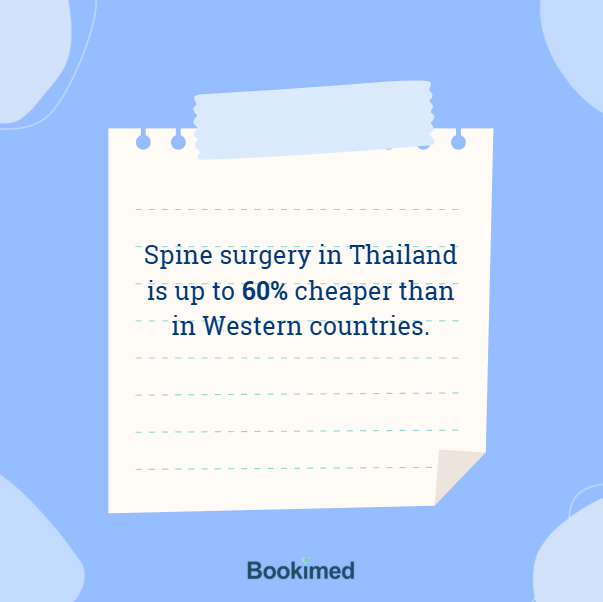
Die Kosten für eine Wirbelsäulenoperation in Thailand liegen im Allgemeinen zwischen 8.000 und 18.000 USD, abhängig vom Verfahren und der verwendeten Technologie, was bis zu 60 % günstiger ist als in den USA oder Australien.
💚 Pakete beinhalten in der Regel Beratungen, Operation, Krankenhausaufenthalt und Nachsorgetermine.
Patienten erholen sich komfortabel in privaten Krankenhauszimmern auf Hotelniveau oder in nahegelegenen Resorts. Rehabilitationszentren in Phuket, Chiang Mai und Bangkok bieten personalisierte Physiotherapieprogramme an, um die Genesung zu beschleunigen und Schmerzen in einer ruhigen, tropischen Umgebung zu lindern.
💚 Über Bookimed können Patienten verifizierte Krankenhäuser für Wirbelsäulenchirurgie vergleichen, echte Bewertungen lesen und exklusive Paketrabatte erhalten – oft günstiger als die direkten Klinikpreise.
Wirbelsäulenchirurgie-Pakete in Thailand sind so strukturiert, dass die Behandlung für internationale Patienten reibungslos verläuft – von der Diagnose bis zur Genesung.
💡Während die meisten großen Krankenhäuser Kerndienstleistungen einschließen, können einige Zusatzleistungen wie robotergestützte Unterstützung oder verlängerte Rehabilitation variieren.
| Höchstwahrscheinlich enthalten | Muss bestätigt werden |
| Präoperative Diagnostik – MRT, CT, Röntgen, Bluttests, EKG. | Verfügbarkeit von 3D-CT-Navigation oder intraoperativem Neuromonitoring. |
| Beratung durch den Wirbelsäulenchirurgen und Anästhesisten. | Zusätzliche Facharztmeinungen (Neurologe, Kardiologe). |
| Operation unter Vollnarkose (minimalinvasiv oder offen). | Aufpreis für roboter- oder lasergestützte Technik. |
| Krankenhausaufenthalt (normalerweise 3–7 Tage, inklusive Mahlzeiten und Pflege). | Intensivstation, Upgrades auf Privatsuiten oder verlängerter Krankenhausaufenthalt. |
| Verwendung eines Standard-Wirbelsäulenimplantats oder Fixationssystems. | Spezifische Implantatmarke – Zimmer Biomet, Medtronic oder Stryker. |
| Medikamente und Schmerztherapie während des Krankenhausaufenthalts. | Medikamente für zu Hause oder Langzeitrezepte. |
| Zwei postoperative Kontrolluntersuchungen vor der Entlassung. | Fern- oder Tele-Nachsorge nach der Rückkehr nach Hause. |
| Grundlegende Physiotherapie und Mobilitätstraining. | Erweiterte Rehabilitation oder Hydrotherapiesitzungen. |
| Flughafen-Krankenhaus-Transfers. | Hotelunterkunft, Stadttransfers und Genesungsunterstützung. |
| Englischsprachiger internationaler Koordinator. | Übersetzer für andere Sprachen (verfügbar über Bookimed). |
💚 Die Buchung über Bookimed ermöglicht den Zugang zu verifizierten Partnerkrankenhäusern, die rabattierte Wirbelsäulenchirurgie-Pakete, transparente Angebote und persönliche Koordination während Ihrer medizinischen Reise anbieten.
Das Land bietet eine vollständige Palette an Wirbelsäuleneingriffen – von minimalinvasiver Dekompression bis hin zu fortschrittlicher Korrektur und Tumorbehandlung.
💡Moderne Krankenhäuser in Bangkok, Phuket und Chiang Mai verwenden navigationsgestützte und robotische Systeme (MAZOR, ROSA), um Präzision und Sicherheit zu verbessern, während zertifizierte Wirbelsäulenchirurgen neurochirurgische und orthopädische Expertise kombinieren.
Krankenhäuser wie die in Bangkok und Phuket gelten als einige der besten Krankenhäuser für Wirbelsäulenchirurgie in Thailand und sind für Laser-Wirbelsäulenoperationen und andere minimalinvasive Optionen ausgestattet.
Klinische Forschung bestätigt, dass die Ergebnisse in Thailand den globalen Standards entsprechen. Eine umfassende Analyse der minimalinvasiven Wirbelsäulenchirurgie (MISS) berichtete von einem Fusionserfolg bei über 80–98 % der Patienten, mit schnellerer Genesung und kürzeren Krankenhausaufenthalten – typischerweise 2–4 Tage weniger als bei offenen Methoden.
Andere Studien zeigen, dass eine Wirbelsäulendekompression bei lumbaler Stenose innerhalb des ersten Monats eine 70–80 %ige Schmerzlinderung bietet, während eine Skoliose-Korrekturoperation eine etwa 78 %ige Kurvenkorrektur erreicht, die über Jahre stabil bleibt.
| Art des Eingriffs | Zweck / Beschreibung | Typische Genesung |
| Minimalinvasive Wirbelsäulenchirurgie (MISS) | Durchgeführt durch kleine Schnitte unter Verwendung von röhrenförmigen Retraktoren, um Gewebetrauma und Blutverlust zu reduzieren. Häufig bei Bandscheibenvorfällen und Spinalkanalstenose. | 1–3 Tage im Krankenhaus; Rückkehr zu leichter Aktivität in 2–4 Wochen. |
| Wirbelsäulendekompressionschirurgie | Entlastet die Nervenkompression durch Entfernung von Knochen- oder Bandscheibenfragmenten (Laminektomie oder Mikrodiskektomie). | 2–5 Tage im Krankenhaus; funktionelle Genesung in 3–6 Wochen. |
| Chirurgische Behandlung von Skoliose | Korrigiert anormale Wirbelsäulenkrümmung mittels Stäben, Schrauben und Knochentransplantaten für verbesserte Ausrichtung und Haltung. | 5–7 Tage im Krankenhaus; vollständige Genesung in 6–12 Monaten. |
| Chirurgische Behandlung von Radikulopathie | Entfernt die Quelle der Nervenwurzelkompression und lindert Schmerzen, Taubheit oder Schwäche in den Gliedmaßen. | 2–4 Tage im Krankenhaus; Symptomlinderung oft innerhalb von Tagen. |
| Vertebroplastie / Kyphoplastie | Stabilisiert Wirbelfrakturen, die durch Osteoporose oder Tumore verursacht wurden, durch Injektion von medizinischem Knochenzement. | Normalerweise ambulant oder 1-tägiger Aufenthalt; Schmerzlinderung innerhalb von 24 Stunden. |
| Operation bei Syringomyelie | Dekomprimiert oder entleert flüssigkeitsgefüllte Zysten (Syrinx) im Rückenmark, um neurologischen Verfall zu verhindern. | 4–7 Tage im Krankenhaus; Kontroll-MRT nach 3 Monaten. |
| Wirbelsäulentumor-Embolisation / Resektion | Reduziert die Durchblutung des Tumors vor der Entfernung oder entfernt Wirbelsäulentumoren direkt, um Kompression und Schmerzen zu lindern. | 5–10 Tage im Krankenhaus, abhängig von Tumorart und -größe. |
| Wirbelsäulenversteifung oder Bandscheibenersatz | Stabilisiert oder ersetzt beschädigte Wirbel/Bandscheiben mit Knochentransplantaten oder künstlichen Implantaten. Häufig bei degenerativen Erkrankungen oder Instabilität. | 4–6 Tage im Krankenhaus; Genesung in 2–3 Monaten. |
💡 In Thailand werden Wirbelsäulenoperationen unter strengen internationalen Sicherheitsstandards durchgeführt, und postoperative Physiotherapie ist in den meisten Rehabilitationsprogrammen enthalten, um Patienten zu helfen, Stabilität und Mobilität schneller wiederzuerlangen.
Die Wirbelsäulenchirurgie in Thailand findet in international akkreditierten Krankenhäusern statt, die fortschrittliche Technologie mit multidisziplinärer Wirbelsäulenversorgung kombinieren.
| Phase | Was passiert |
| 1. Präoperative Untersuchung | MRT, CT und Bluttests helfen bei der Identifizierung von Wirbelsäulenerkrankungen wie Spinalkanalstenose, Skoliose oder Wirbelsäulentumoren. Chirurgen entwickeln einen maßgeschneiderten Plan, um die Stabilität der Wirbelsäule wiederherzustellen und chronische Rücken- oder Nackenschmerzen zu lindern. |
| 2. Anästhesie und Positionierung | Eine Vollnarkose wird verabreicht. Der Patient wird sorgfältig positioniert, um vollen Zugang zum betroffenen Wirbelsäulensegment zu ermöglichen und gleichzeitig den Gewebedruck zu minimieren – entscheidend für minimalinvasive und endoskopische Verfahren. |
| 3. Chirurgischer Zugang | Kleine Schnitte werden für endoskopische Wirbelsäulenoperationen oder transforaminale/anteriore lumbale interkorporelle Fusionen vorgenommen. Standardansätze werden für Deformitätskorrekturen oder Tumorentfernungen verwendet. |
| 4. Kernbehandlung |
|
| 5. Implantatplatzierung | Hochwertige Implantate von Zimmer Biomet, Medtronic und Stryker werden verwendet, um die Wirbelsäule zu verstärken und das Gleichgewicht wiederherzustellen. |
| 6. Verschluss und Überwachung der Genesung | Der Schnitt wird mit resorbierbaren Fäden verschlossen. Patienten werden in spezialisierten Aufwach- oder Intensivstationen überwacht, um postoperative Schmerzen zu behandeln und die neurologische Funktion zu verfolgen. |
Die meisten Wirbelsäulenoperationen in Thailand dauern 2–5 Stunden, abhängig von der Komplexität.
💚 Über Bookimed können internationale Patienten verifizierte Kliniken vergleichen, auf transparente Pakete für Wirbelsäulenchirurgie in Thailand zugreifen und Unterstützung während der gesamten Behandlung und Genesung erhalten.
Die Genesung ist darauf ausgelegt, Patienten zu helfen, ihre Mobilität schnell und sicher wiederzuerlangen. Multidisziplinäre Teams aus Wirbelsäulenchirurgen, Physiotherapeuten und Schmerzspezialisten leiten jede Phase der Heilung, wobei der Fokus auf der Schmerzreduktion und der Wiederherstellung der Funktion liegt.
Die Rehabilitation beginnt normalerweise innerhalb von 24–48 Stunden. Bei minimalinvasiver Wirbelsäulenchirurgie ist der Krankenhausaufenthalt kürzer und die Mobilität kehrt schneller zurück als bei traditionellen offenen Verfahren.
| Genesungsphase | Typischer Fortschritt |
| Tag 1–2 | Beginn sanfter Bewegung und assistiertem Gehen. Schmerzbehandlung mit Medikamenten. |
| Tag 3–5 | Entlassung mit einem personalisierten Physiotherapieplan und Bewegungsvorsichtsmaßnahmen. |
| Woche 1–2 | Schwellung und Steifheit lassen nach; tägliches Dehnen und Gehen werden gefördert. |
| Woche 4–6 | Die meisten Patienten kehren zu normalen Routinen und leichter Arbeit zurück. |
| Monat 3–6 | Vollständige Genesung erreicht; Nachsorge (online oder persönlich) bestätigt die Stabilität der Wirbelsäule. |
Viele Krankenhäuser bieten auch Hydrotherapie, Muskelkräftigungssitzungen und Haltungskorrektur an, um die langfristige Wirbelsäulengesundheit zu unterstützen.
💚 Patienten, die über Bookimed buchen, können auf strukturierte Rehabilitationspakete zugreifen, einschließlich Physiotherapie und Nachsorge, in verifizierten Krankenhäusern, die Wirbelsäulenbehandlungen nach internationalem Standard anbieten.
Wirbelsäuleneingriffe in Thailand werden unter strengen chirurgischen und hygienischen Protokollen durchgeführt, die mit denen in westlichen Ländern vergleichbar sind. Operationssäle nutzen Echtzeit-Bildgebung, Neuromonitoring und Luftfiltersysteme, um Präzision und Sterilität während der gesamten Operation aufrechtzuerhalten.
Klinische Daten aus Langzeitnachsorgen in thailändischen Krankenhäusern zeigen eine 95–98 %ige Erfolgsrate bei Wirbelsäulenversteifungs- und Dekompressionsoperationen, wobei die meisten Patienten eine signifikante Schmerzreduktion und wiederhergestellte Mobilität berichten.

👉Wirbelsäulenchirurgie bei degenerativen oder traumatischen Erkrankungen ist sehr sicher, wobei die meisten Patienten mindestens 15 Jahre nach dem Eingriff leben.
Geringfügige Wundinfektion oder Blutung;
Kurzfristige Taubheit oder Nervenreizung;
Lockerung des Implantats oder Revisionsoperation in komplexen Fällen.
Thailändische Wirbelsäulenchirurgen aktualisieren ihre Methoden kontinuierlich durch internationale Stipendien und Trainingsprogramme in den USA, Japan und Europa – was aktuelle Expertise und eine sichere Genesung für Patienten gewährleistet.
💚 Verifizierte Krankenhäuser, die mit Bookimed zusammenarbeiten, teilen transparente Ergebnisdaten und bieten dedizierte postoperative Unterstützung für Medizintouristen, die eine fortschrittliche Wirbelsäulenversorgung in Thailand suchen.
Thailändische Krankenhäuser berichten von Erfolgsquoten zwischen 85 % und 95 % bei Standard-Wirbelsäulenversteifungen. Minimalinvasive Eingriffe erreichen aufgrund geringerer Infektionsrisiken oft eine Erfolgsquote von 95 %. JCI-akkreditierte Einrichtungen in Bangkok und Pattaya verwenden Medtronic-Technologie, um internationale Sicherheitsstandards für komplexe Wirbelsäulenfälle zu erfüllen.
Bookimed-Experteneinblick: Thailändische orthopädische Zentren zeigen eine hohe Korrelation zwischen Patientenaufkommen und Ergebnisstabilität. Das Bumrungrad International Hospital behandelt jährlich 1.000.000 Patienten. Dieser enorme Umfang ermöglicht es Chirurgen, Techniken in hochintensiven Umgebungen zu verfeinern. Kliniken mit mehr als 50 spezialisierten Ärzten bieten in der Regel vorhersehbarere Ergebnisse bei Skoliose- und Bandscheibenoperationen.
Patientenkonsens: Patienten stellen fest, dass die Ergebnisse am zuverlässigsten sind, wenn komplexe Revisionen vermieden werden, sofern zugrunde liegende gesundheitliche Probleme bestehen. Viele betonen, dass eine Fernüberprüfung des MRT durch Spezialisten hilft, das 95%ige Erfolgspotenzial vor der Reise zu bestätigen.
Thailändische Wirbelsäulenchirurgen sind hochqualifiziert für die Durchführung fortschrittlicher Eingriffe wie endoskopische Operationen und Skoliosekorrekturen. Viele verfügen über Stipendien renommierter Institutionen wie der Yale School of Medicine oder der UCLA. Führende Einrichtungen in Bangkok verfügen über eine JCI-Akkreditierung und nutzen fortschrittliche Navigationssysteme von Stryker und Medtronic für komplexe Fälle.
Experteneinblick von Bookimed: Thailändische orthopädische Zentren zeigen ein starkes Muster internationaler Zusammenarbeit. So absolvierte Dr. Wuttichai Sutantavibul allein im Jahr 2023 spezialisierte Fellowships in Südkorea und Japan. Diese ständige grenzüberschreitende Ausbildung stellt sicher, dass Patienten in Bangkok die gleichen mikroendoskopischen und perkutanen Techniken erhalten, die auch in den technologisch fortschrittlichsten medizinischen Zentren der Welt angewendet werden.
Patientenkonsens: Patienten merken an, dass Chirurgen häufig Stipendien von führenden westlichen Institutionen wie der Mayo Clinic haben. Viele empfehlen, zunächst eine Videokonsultation zu vereinbaren, um den Kommunikationsstil und die Expertise des Chirurgen zu bestätigen.
Privatkliniken in Thailand haben keine nennenswerten Wartelisten für Wirbelsäuleneingriffe. Internationale Patienten planen elektive Operationen wie Diskektomien oder Versteifungen oft innerhalb weniger Tage. Diese JCI-akkreditierten Einrichtungen stehen in krassem Gegensatz zu den langen Wartezeiten im öffentlichen Gesundheitswesen. Patienten schließen Beratungen und Diagnostik in der Regel innerhalb einer Woche ab.
Bookimed-Expertenmeinung: Daten deuten darauf hin, dass ein hohes Patientenaufkommen in großen Zentren die Wartezeiten tatsächlich verkürzt. Krankenhäuser wie das Bumrungrad International behandeln jährlich 1 Million Patienten und beschäftigen 1.300 Ärzte. Diese massive Infrastruktur ermöglicht es ihnen, mehrere Operationssäle gleichzeitig zu betreiben. Für Patienten bedeutet dies, dass eine Lendenwirbelversteifung an einem Dienstag für eine Operation am Freitag gebucht werden kann.
Patientenkonsens: Patienten sind oft überrascht, dass sie am Montag eine Beratung und in der nächsten Woche eine Operation haben können. Sie stellen fest, dass die Schnelligkeit in thailändischen Privatkliniken eine große Erleichterung im Vergleich zu monatelangen Wartezeiten zu Hause darstellt.
Minimalinvasive Wirbelsäulenchirurgie ist in Thailand an JCI-akkreditierten Einrichtungen weit verbreitet. Chirurgen führen fortgeschrittene Verfahren wie endoskopische Diskektomie und robotergestützte Fusion durch. Diese Techniken verwenden kleine Schnitte, um Gewebeschäden zu verringern. Die meisten Patienten erleben schnellere Erholungszeiten von 1–2 Wochen im Vergleich zur traditionellen Chirurgie.
Bookimed-Expertise: Daten aus Bangkoker Krankenhäusern wie dem KDMS Specialized Orthopedic Hospital zeigen einen Trend zur Hypert-Spezialisierung. Hoch bewertete Kliniken widmen oft ganze Etagen spezifischen Wirbelsäulenpathologien anstelle allgemeiner Orthopädie. Diese Konzentration von Geräten und spezialisiertem Personal hilft Chirurgen, hohe Eingriffsvolumina für komplexe MIS-Fälle aufrechtzuerhalten.
Patientenkonsens: Patienten betonen die Bedeutung der Überprüfung präoperativer Bildgebung durch mehrere Spezialisten. Sie merken an, dass die Überprüfung der Erfahrung eines Chirurgen mit über 200 MIS-Fällen pro Jahr zu vorhersehbareren Ergebnissen führt.
Die meisten Patienten müssen nach einer Wirbelsäulenoperation 7 bis 21 Tage in Thailand bleiben. Die genaue Dauer hängt vom Typ des Eingriffs und dem Fortschritt der Genesung ab. Chirurgen in JCI-akkreditierten Einrichtungen wie dem Bumrungrad International Hospital benötigen dieses Zeitfenster, um mögliche Komplikationen zu überwachen und die Sicherheit für Flugreisen zu gewährleisten.
Buchimed Experteneinschätzung: Daten zeigen, dass die Wahl einer spezialisierten Einrichtung wie dem KDMS Specialized Orthopedic Hospital den Genesungsprozess optimieren kann. Diese spezialisierten Zentren haben oft ein höheres Aufkommen an orthopädischen Patienten als allgemeine Krankenhäuser. Dieser Fokus führt zu effizienteren postoperativen Protokollen. Patienten sollten überprüfen, ob ihr Paket lokale Transfers für Folgeuntersuchungen der Wunde umfasst. Dieses kleine Detail reduziert die körperliche Belastung während der kritischen ersten 2 Wochen erheblich.
Patientenkonsens: Patienten betonen, flexible Unterkünfte in der Nähe des Krankenhauses zu buchen, um den täglichen Zugang zu Wundkontrollen zu erleichtern. Viele empfehlen, 3 bis 5 Puffertage zu ihrem Aufenthalt hinzuzufügen, um auf unerwartete Schwellungen vor der Heimreise vorbereitet zu sein.
Der Rückflug nach einer Wirbelsäulenoperation ist im Allgemeinen sicher, wenn man bestimmte klinische Zeitpläne einhält. Die meisten Chirurgen in Thailand empfehlen, 4 bis 6 Wochen mit internationalem Reisen zu warten. Dieser Zeitraum ermöglicht die anfängliche Heilung und reduziert Risiken wie tiefe Venenthrombose (TVT) oder starke Schmerzschübe.
Experteneinsicht von Bookimed: Thailändische orthopädische Krankenhäuser wie das KDMS Specialized Orthopedic Hospital konzentrieren sich ausschließlich auf Knochen- und Gelenkerkrankungen. Diese Spezialisierung führt häufig zu konservativeren, sicherheitsorientierten Reisezeiträumen. Unsere Daten zeigen, dass Kliniken mit hohem internationalem Aufkommen, wie das Sikarin Hospital, häufig spezialisierte postoperative Überwachungen einführen, um sicherzustellen, dass Patienten die flugbereiten Kriterien sicher erfüllen.
Patientenkonsens: Patienten betonen, dass Veränderungen des Kabinendrucks unerwartete Rückenschwellungen und Unbehagen verursachen können. Viele Reisende empfehlen, Gangplätze zu buchen, um das Aufstehen und Dehnen bei langen Heimflügen zu erleichtern.
Typische thailändische Wirbelsäulenoperationspakete umfassen den primären Eingriff, Operationssaalgebühren und standardmäßige Anästhesie. Die meisten Pläne beinhalten einen Krankenhausaufenthalt von 3 bis 5 Nächten in einem privaten Zimmer. Diagnostische Tests wie Röntgenaufnahmen oder CT-Scans sind oft gebündelt, um eine sofortige präoperative Planung zu erleichtern.
Bookimed-Expertenmeinung: Daten zeigen, dass Kliniken mit hohem internationalem Volumen, wie das Bumrungrad International Hospital, KI und Robotersysteme einsetzen, um die Präzision zu erhöhen. Während grundlegende Pakete standardmäßige Operationen abdecken, sollten Patienten überprüfen, ob diese fortschrittlichen Robotertechnologien enthalten sind oder einen Aufpreis erfordern. Zentren mit hohem Volumen bieten oft eine umfassendere postoperative Überwachung innerhalb ihrer Grundgebühren an.
Patientenkonsens: Patienten betonen, dass es entscheidend ist, zu klären, ob spezialisierte Wirbelsäulenimplantate enthalten sind oder zusätzliche Kosten verursachen. Viele empfehlen, für einen 2–4-wöchigen Aufenthalt vor Ort zu budgetieren, da langfristige Reha und Flüge selten Teil des ursprünglichen Pakets sind.
Alle medizinischen Inhalte auf dieser Seite werden von Autoren mit spezialisierter medizinischer Ausbildung erstellt und von zertifizierten Fachärzten des jeweiligen Fachgebiets überprüft. Medizinische Überprüfung durch Fahad Mawlood, Medizinischer Redakteur und Data Scientist.
Zuletzt aktualisiert: 10/24/2026.
Alle Daten dienen ausschließlich allgemeinen Informationszwecken und spiegeln möglicherweise nicht individuelle Ergebnisse oder Erfahrungen wider.