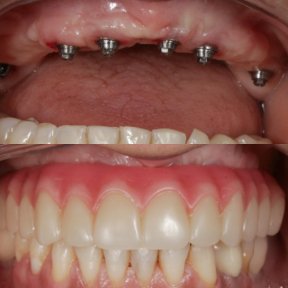
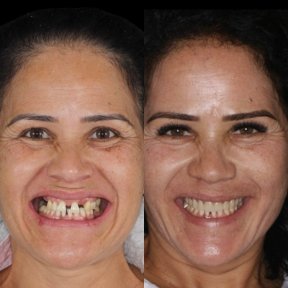
With dental implants in Brazil, the groundwork for a lasting All-on-6 result begins before surgery day, during pre-surgery planning. Four things decide the ten-year outcome: how many implants carry the bridge, and how ready your gums are. The rest is the hardware in your jaw and your upkeep at home. Price and a clinic's reputation matter too.
All-on-6 vs All-on-4: What Do the Two Extra Implants Add?
Four implants can hold a full arch, so why do clinics recommend six for heavy-bite patients? The extra pair protects the bone. In upper-jaw bridges, six implants cut long-term bone loss by more than 50%, with fewer technical and biological problems.
In a direct four-versus-six comparison, five-year survival stays close – about 98.6% on four implants, 99.4% on six.
| Parameter | All-on-4 | All-on-6 | What it means for you |
|---|
| Implants placed | Four | Six | More anchor points share the load |
| How biting force is shared | Across four points | Across six points | Six spreads each bite more evenly |
| Success rate with regard to mechanical problems (e.g., loose screws, cracked framework) | 79.3% success rate | 82.1% success rate | Slightly more trouble-free with six, though the gap is small |
| Best-suited patient | Firm bone and a lighter bite | Grinders, heavy bites, or major bone loss | Match the design to your bite and bone |
Specialists keep six implants for heavy grinding, major bone loss, or a full firm bite against the new arch. A prosthodontist who performs both protocols, such as Dr. Guilherme Vital Rodrigues, can advise which one fits your bite.
Preparing for All-on-6 After Gum Disease
A history of severe gum disease doesn't rule out All-on-6 – it changes the order. The gums must settle before any implant goes in.
How a gum-disease history changes the plan
All-on-6 stays dependable after past gum disease when the gums settle first. Over ten years, about 90% of implants stayed in place in people treated for gum disease, and about 96% in people with no history of it. What decided the outcome was upkeep: patients who skipped their maintenance visits were about eight times more likely to lose an implant. European gum-health guidance asks for at least six months of documented gum stability before surgery.
An oral and maxillofacial surgeon, such as Dr. Augusto Sebba, evaluates bone structure and clears active infection before placing full-mouth implants.
The checks a clinic runs before surgery
Before you commit to surgery, a clinic confirms the gums are ready with a few standard checks:
- Very little bleeding when the gums are probed, under 15%.
- Low plaque overall, under 20%.
- No deep gum pockets that bleed at 5 mm or more.
- No fresh bone loss on the X-ray.
If any check is off, treat the gums first. Place the implants once they hold steady.
Same-Day Teeth: Can You Get Fixed Teeth the Same Day?
Fixed teeth on the same day are common. In a study of 1,200 immediately loaded arches, about 98% of implants were still in place five years later. They're never automatic, though, and soft bone can change the plan.
When same-day teeth are possible
Surgeons judge the grip two ways at placement: how tightly each implant threads into bone and an implant-stability score. If both checks confirm a solid fit, a temporary fixed bridge can go on within a day or two.
Clinics that plan the surgery in 3D, such as Clínica Zago with NemoScan, guide each implant into the firmest bone.
If your bone needs more time
If the bone is too soft to reach that grip, the safe choice is to wait. The implants heal under the gum for two to three months. You wear a removable temporary in the meantime, so build that into your travel plans. A short wait protects the final result.
Why the Implant Connection Shapes Long-Term Bone Health
Two implants of the same brand can age differently, depending on the joint that carries the tooth. An analysis of 45,347 implants shows that joint shape directly affects how much bone stays intact near the gumline. A Morse-taper, a cone-shaped internal connection, preserves the highest amount of supporting jawbone.
| Connection type | Average bone loss | What it means for you |
|---|
| External-hex joint (a flat joint that sits on top of the post) | About 1.03 mm | An older design with more bone change over time |
| Wide cone joint | About 0.73 mm | Keeps more bone than a flat joint |
| Narrow cone-shaped internal joint (Morse-taper) | About 0.45 mm | Keeps the most bone and seals out bacteria |
That cone-shaped seal also keeps bacteria from leaking into the implant, which lowers mechanical problems later on. This choice affects durability for years. It's fair to ask your surgeon which connection a system uses. Brazilian centers such as Odontoliuzzi place Straumann systems, which use that cone-shaped internal connection.
Your Permanent Bridge Material
The final bridge fixed onto your implants is a separate choice from the implants themselves. The material determines how well the smile holds up to daily use.
The most durable bridge material
Solid, one-piece zirconia is the most durable option. It keeps about 97% of prostheses still working at four years, with few major technical problems. Ceramic layered over a metal or zirconia frame looks natural but chips far more often, in roughly 15%–54% of cases. That sometimes means a full replacement. For an arch you'll use for years, the one-piece choice trades a bit of natural tooth realism for far fewer repairs.
If you grind your teeth
Regular teeth-grinding during sleep, known as bruxism, roughly doubles the risk of an implant failure. That makes the material and a protective plan matter even more. A sensible plan for grinders combines several steps:
- The six-implant layout to share the bite
- A solid zirconia bridge for strength
- A cone-shaped implant connection
- A custom hard night guard for sleep
- Regular professional check-ups
Brazil's Premium Implant Brands
Brazil makes several of its own premium implant brands. Patients get top-quality hardware without the mark-ups added to imported systems.
Brazil's home-grown implant brands
Neodent, made in Curitiba, is now part of the Swiss Straumann Group. S.I.N., another Brazilian maker, was acquired by Henry Schein. Both use the cone-shaped internal connection that holds bone well at the neck.
Modern implants are also built to last. One study followed 10,871 implants: about 97% were still in place at 10 years and 94% at 15 years.
What a warranty actually covers
A manufacturer's lifetime warranty replaces the titanium implant itself in the event of a proven defect. It doesn't usually cover:
- The surgery to place or replace an implant.
- The lab work and the new bridge.
- The anesthesia and clinic time.
- The flights and hotels for a return trip.
Your Bookimed coordinator can confirm exactly what a given warranty covers.
Caring for Your Implants After You Fly Home
Implants are long-lasting, but not maintenance-free. What keeps them healthy is regular professional cleaning and a check-up once you're back home.
Why maintenance protects the result
Structured professional care pays off. According to studies, maintenance cuts the risk of gum-and-bone infection around the implant by about 75%. Over one to seven years, 96% of people who kept up their maintenance visits stayed free of peri-implantitis.
Your check-up schedule at home
How often you need routine check-ups depends on your risk factors. Your local dentist can handle these visits.
| Risk level | Check-up every | Who this is |
|---|
| Lower | 6 months | Healthy gums, no grinding, non-smoker |
| Moderate | 4 months | Ex-smokers, or diabetes that's under control |
| Higher | 3 months | Smokers, a gum-disease history, or grinders |
Line up these cleanings with a dentist at home before you travel, so your care continues without a gap. A periodontics-focused dentist, such as Dr. Alexandre Teixeira Neto, can also set the plan you'll follow.